


From a traditional perspective, data centers have been evaluated based on scale, processing power, and scalability. The more servers and resources deployed, the greater the advantage. However, the era of artificial intelligence is forcing the industry to fundamentally rethink this foundation. As computational demand surges to unprecedented levels, a factor once considered secondary has emerged to dominate the entire equation: electricity. And at the center of this energy challenge lies the chip.
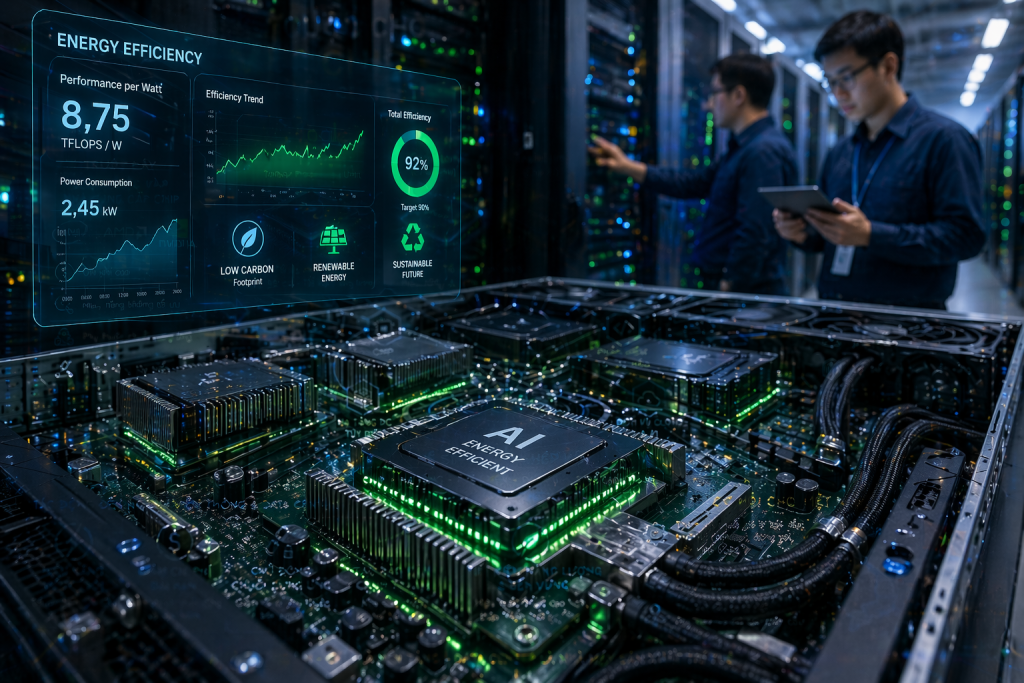
No longer is performance alone the defining metric. Today, chips are judged by a far more demanding standard: performance per watt. This reflects an unavoidable reality: in modern data center operations—especially those serving AI workloads—electricity cost is not just an expense, it is a constraint. A system, no matter how powerful, becomes economically inefficient if it consumes excessive energy. Conversely, an energy-optimized architecture can deliver sustainable competitive advantage, even if its absolute performance is not the highest.
At this point, the role of the chip must be fundamentally reconsidered. If chips were once tools for accelerating computation, they have now become direct determinants of cost structure. Manufacturers such as NVIDIA, AMD, and Intel continue to push performance boundaries, but the pressure to improve energy efficiency is intensifying. Meanwhile, technology giants like Google, Amazon, and Microsoft are approaching the problem from a deeper level: rather than waiting for the market to provide solutions, they are proactively designing chips to control the energy equation from the ground up.
This shift is not optional—it is the inevitable result of operational pressure. Modern AI models, particularly large-scale deep learning systems, require trillions of computations. When deployed at industrial scale, energy consumption becomes impossible to ignore. A single AI data center can consume as much electricity as a small urban district. In this context, every architectural decision must answer a fundamental question: how much value does each watt of electricity generate?
From here, the trend toward energy-efficient chips becomes irreversible. But energy efficiency is not simply about reducing power consumption—it is about holistic optimization. An efficient chip is one that does not waste energy on unnecessary functions, does not generate excessive heat, and does not introduce avoidable latency in data processing. This has led to the rise of specialized chips, particularly ASICs for AI—processors designed for a single purpose, yet achieving maximum efficiency in that purpose.
The difference between general-purpose chips and specialized chips is not merely architectural; it is philosophical. General-purpose chips aim to do many things, while specialized chips aim to do one thing exceptionally well. In the context of AI—where workloads are predictable and highly optimizable—the latter approach is increasingly rational. This is why Google developed TPU, and Amazon developed Trainium. These chips are not intended to fully replace GPUs, but to solve specific problems with significantly higher energy efficiency.
From an economic standpoint, this transformation leads to a pivotal conclusion: designing chips is effectively designing profit. As electricity costs account for an increasing share of total operating expenses, optimizing chip architecture directly translates into optimizing cash flow. A marginal improvement in energy efficiency can yield massive financial gains when scaled across tens of thousands of servers. Conversely, a poor architectural choice can undermine the sustainability of an entire business model.
Notably, when chips evolve, the entire data center must evolve with them. From cooling systems and rack design to power infrastructure layout, everything must adapt to the energy consumption characteristics of the chips. This reveals a reverse relationship: not only do data centers determine how chips are used, but chips are increasingly shaping how data centers are built.
At a deeper level, the issue of energy efficiency is also tied to a broader concern: sustainability. As the world places greater emphasis on carbon emissions and energy consumption, data centers can no longer expand in the traditional way. Energy efficiency is no longer just a competitive advantage—it is a requirement for long-term viability. Systems that consume excessive power will face not only cost pressures, but also regulatory and societal scrutiny.
From all these perspectives, it is clear that the data center race is being redefined. It is no longer a competition of absolute power, but a competition of efficiency. In this race, chips are no longer just technical components—they are strategic levers.
And thus, a new principle is emerging in the technology industry:
Electricity costs are defining the data center race. And designing chips is, ultimately, designing profit.