


China continues to demonstrate its semiconductor self-reliance by building several AI training systems powered entirely by domestically produced chips.
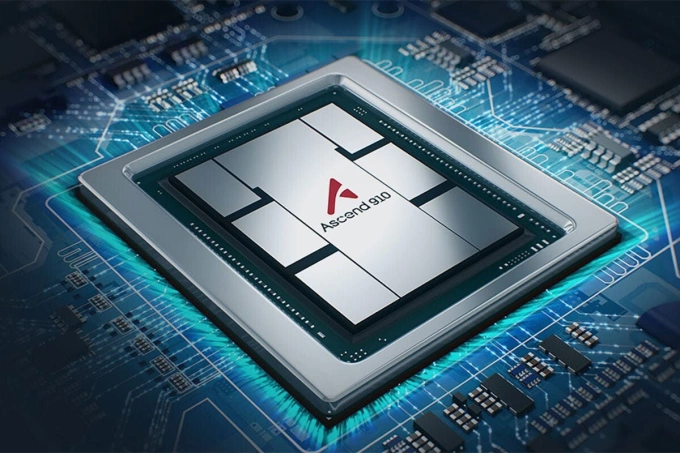
On March 31, Chinese media reported that the city of Shenzhen had begun operating an intelligent computing cluster containing 10,000 Ascend 910C chips manufactured by Huawei. The cluster delivers a computing capacity of 11,000 petaflops (quadrillions of calculations per second).
Combined with a 3,000-petaflop cluster launched last year, the facility now reaches a total computing capacity of 14,000 petaflops. Nearly 50 organizations have signed framework agreements to utilize the cluster’s computing power, pushing its combined reservation rate to 92%.
Zhang Luncheng, Vice President of startup X Square Robot, noted that Shenzhen’s upgrades in both scale and quality of computing capacity have positioned the city as a leading national hub. More importantly, it highlights significant progress in technological self-sufficiency.
According to research published earlier this year by DeepSeek, the Ascend 910C delivers approximately 60% of the performance of Nvidia’s H100. The chip is designed by Huawei and manufactured by SMIC.
Huawei also introduced a new AI chip, the Ascend 950PR, last year. According to Reuters, major Chinese tech giants such as ByteDance and Alibaba are planning to place orders for the new chip. Huawei is preparing to release around 750,000 units of the 950PR and 600,000 units of the Ascend 910C this year.
Shenzhen is also targeting an increase in real-time AI computing capacity to 80,000 petaflops this year. The China Academy of Information and Communications Technology estimates that by the end of June 2025, China’s total computing capacity will reach 962,000 petaflops, accounting for 21% of the global total—up 73% year-over-year.
A report released by IDC on March 31 also shows that Chinese GPU and AI chip manufacturers are expected to account for nearly 41% of the country’s AI server market in 2025. This achievement comes as Beijing grows increasingly cautious about dependence on foreign chips, encouraging government agencies and companies to adopt domestic alternatives.
According to the data, the total number of AI accelerator chips supplied by Nvidia, AMD, and Chinese manufacturers is projected to reach around 4 million units in 2025. Nvidia remains the market leader, shipping 2.2 million chips and holding a 55% market share, while AMD accounts for approximately 160,000 units, or 4%.
The remainder comes from Chinese companies. Huawei leads with 812,000 AI chips, representing about half of all domestically branded chips. Alibaba’s T-Head design unit ranks second with 265,000 units shipped. Baidu’s Kunlunxin and Cambricon each deliver 116,000 chips, placing third and fourth respectively. Hygon, along with GPU startups MetaX and Iluvatar CoreX, account for 5%, 4%, and 3% of total AI accelerator shipments.
Analysts believe that the market positions of Nvidia and AMD could be challenged in the near future as domestic companies ramp up production. Earlier, the Financial Times reported that the world’s leading AI chipmaker had halted plans to produce the H200 chip—originally designed for Chinese customers—despite receiving approval from the U.S. government. Meanwhile, The Information reported that earlier this year, China instructed tech companies to avoid ordering Nvidia’s H200 chips and instead prioritize domestic AI chip solutions.
(Source: vnexpress.net)