


In the digital age, where data drives everything from e-commerce, banking to artificial intelligence, the need for stability and availability of IT systems is becoming increasingly important. One of the most popular and reputable standards for assessing the reliability of data centers today is Uptime Tier, developed by Uptime Institute (USA).
So, what is Uptime Tier, why is it important and what does each level represent? Let's find out in a specific and easy-to-understand way through the explanation below.
📌 What is the concept of Uptime Tier?
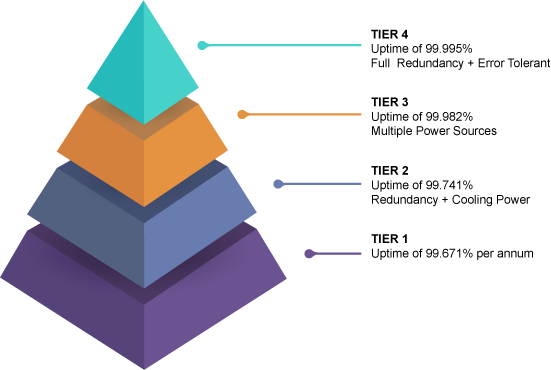
Uptime Tier is a system for classifying data centers based on availability and redundancy. The higher the tier, the more continuous and fault-tolerant the system is, while the investment and operating costs also increase.
This classification system consists of 4 levels: Tier I, II, III and IV. Each level represents a different level of commitment to annual uninterrupted operation time (in percentage – uptime), maintainability and recovery from incidents.
🔸 Tier I – Minimal infrastructure, suitable for environments that do not require continuous
Tier I is considered the most basic level. In this model, the data center has only a single power and cooling line, with no redundancy. If one component in the system fails or requires maintenance, the entire service can be interrupted.
- Uptime: ~99,671%
- Maximum downtime per year: ~28.8 hours
This model is suitable for test systems, small offices, or businesses that are not too dependent on 24/7 data.
🔸 Tier II – Local Redundancy Begins
Tier II is a step up from Tier I. While still using a single main power supply, the system has been supplemented with individual redundant components (N+1) for power, cooling, and UPS (uninterruptible power supply). This reduces the risk of downtime when a piece of equipment requires maintenance.
- Uptime: ~99,749%
- Maximum downtime per year: ~22 hours
Tier II is suitable for medium-sized businesses where the system needs more stability but is still not mission-critical.
🔸 Tier III – Maintainability without service interruption
Tier III is the most common level used in modern data centers. The biggest advantage of Tier III is the ability to maintain any component of the system without shutting down the entire operation – this is called “Concurrently Maintainable”. This means that the data center can continue to operate normally while a piece of equipment is being repaired or replaced.
- Uptime: ~99,982%
- Maximum downtime per year: ~1.6 hours
Tier III is suitable for financial institutions, cloud service providers, governments, or 24/7 operators with high requirements.
🔸 Tier IV – Fully redundant, operates even in the event of a major failure
Tier IV is the highest and most stringent level of the Uptime Tier system. All systems have complete redundancy (2N or 2N+1) – meaning that two independent systems can operate simultaneously. If one system fails, the remaining system ensures that the data center continues to operate normally.
Additionally, Tier IV is fault tolerant, meaning it can handle failures without causing disruption, even during major incidents.
- Uptime: ~99,995%
- Maximum downtime per year: ~26 minutes
Tier IV is the top choice for national critical systems, data centers serving artificial intelligence, big data analytics, or central banks.
📊 Tier Comparison Summary
| Tier | Redundancy | Uptime | Downtime/year | Typical applications |
| Tier I | No | 99,671% | ~28,8 hours | Small office, test system |
| Tier II | N+1 single | 99,749% | ~22 hours | Medium Enterprise |
| Tier III | N+1 maintainability | 99,982% | ~1,6 hours | Banking, data center services |
| Tier IV | 2N (dual redundancy) | 99,995% | ~26 minutes | National Data Center, AI, Big Data |
🎯 Which Tier should a business choose?
Choosing which standard data center to use depends on:
- Nature of business (does the service require 24/7 operation)
- Initial investment budget and operating costs
- Acceptable risk of system disruption
- Legal or security compliance requirements
For example, a startup might start with Tier II infrastructure to save costs, then upgrade to Tier III or IV as business scale and requirements grow.
Uptime Tier is more than just a technical ranking – it is a measure of reliability, a commitment to the stable operation of a data center in the digital age. Understanding Uptime Tier levels not only helps businesses choose the right infrastructure, but also lays the foundation for building secure, sustainable and competitive digital services in the long term.