


In the economic development strategies of many countries, logistics is increasingly regarded as the “circulatory system” of the economy. If transportation infrastructure represents the physical arteries, then digital technology acts as the nervous system that coordinates the entire modern supply chain. In Vietnam, particularly in Ho Chi Minh City — the country’s largest economic hub — the logistics sector is entering a period of rapid transformation as the city aims to become a regional logistics center in Southeast Asia. Alongside investments in ports, warehouses, and transportation connectivity, the application of technology in logistics is becoming a decisive factor for future competitiveness.
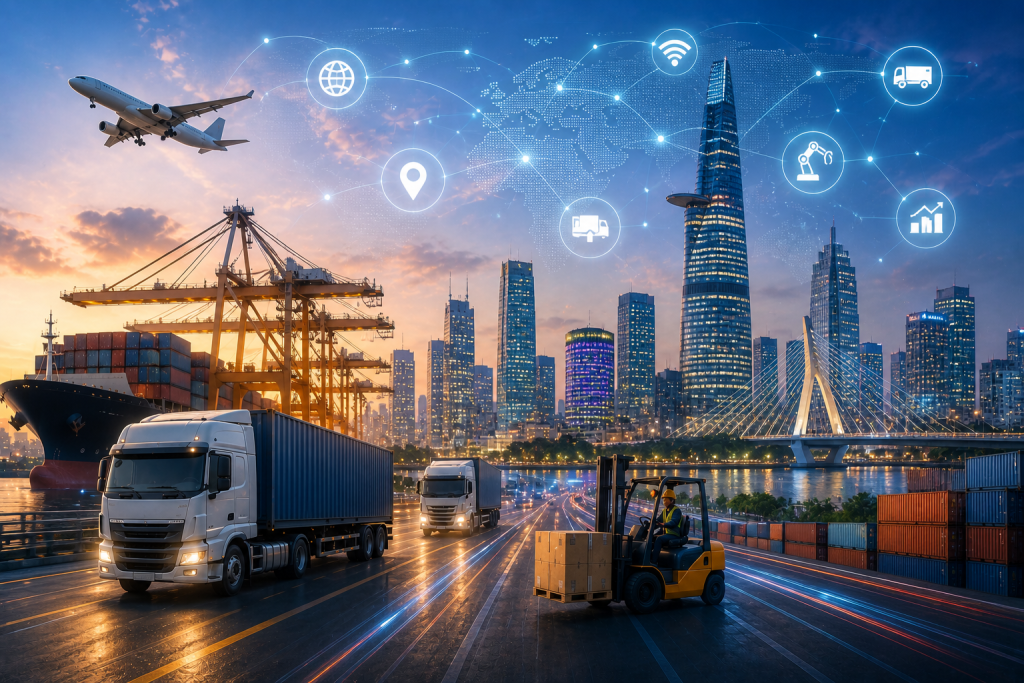
For many years, logistics was commonly understood as simply the transportation and storage of goods. However, under the impact of e-commerce, artificial intelligence (AI), and digital transformation, the concept of logistics has changed dramatically. Today, a modern logistics center is no longer merely a place for containers and cargo, but also a real-time data processing hub. Activities such as warehouse management, vehicle coordination, cargo tracking, inventory control, and market demand forecasting are now being rapidly digitized.
With the advancement of technology, logistics is gradually evolving into a data-driven industry. Technologies such as AI, the Internet of Things (IoT), cloud computing, Big Data, automation robotics, and blockchain are reshaping the entire global supply chain ecosystem. Smart warehouse management systems can automatically classify goods, optimize storage locations, and significantly shorten order processing times. Modern transportation management software can analyze traffic data in real time to select the most efficient delivery routes, reducing fuel consumption and operational costs.
In developed countries, high-tech logistics has already become the new standard. Amazon operates hundreds of thousands of robots in its smart warehouses to reduce order processing times to just minutes. Advanced seaports in Singapore and Rotterdam are using AI to automate container coordination, reduce congestion, and improve operational efficiency. This demonstrates that competition in the logistics industry today is no longer determined by the number of trucks or warehouse capacity, but by data processing speed and technological capability.
In Vietnam, Ho Chi Minh City is actively promoting the development of large-scale logistics centers to leverage its seaport system, industrial infrastructure, and strategic position as the economic gateway of Southern Vietnam. Logistics zones are being planned in areas such as Cat Lai, Long Binh, Linh Trung, and regions connected to the future Long Thanh International Airport. However, amid the rapid growth of e-commerce and increasing demand for fast delivery services, traditional logistics infrastructure alone will no longer be sufficient without the integration of advanced technology.
The growth of modern logistics also means that the volume of generated data is increasing exponentially. Data from transportation systems, AI cameras, GPS tracking, e-commerce orders, IoT devices, warehouse management platforms, and electronic customs systems all require continuous high-speed processing. As a result, the development of modern logistics is now inseparable from digital infrastructure, particularly Data Centers.
In the digital economy, Data Centers are becoming the “brain” of the logistics ecosystem. They store, process, and operate millions of data transactions every day to support AI platforms, cloud computing, and intelligent supply chain management systems. Leading global logistics companies are heavily investing in Data Centers to enhance operational efficiency and optimize costs.
According to technology experts, in the near future, countries with stronger digital infrastructure will hold greater advantages in controlling global supply chains. This is why many nations are aggressively investing in Data Centers, AI, and digital infrastructure as part of their preparation for the next generation of smart logistics.
Following this trend, many Vietnamese enterprises have begun investing in digital infrastructure to support the country’s digital transformation. Among them, DCH is developing a digital technology ecosystem associated with AI Data Centers and platforms designed to serve logistics enterprises, e-commerce, and intelligent supply chain systems.
DCH’s AI Data Center project is expected to commence deployment by the end of 2025 in Ba Ria – Vung Tau Province, an area emerging as one of Vietnam’s strategic logistics and seaport hubs. With direct connectivity to the Cai Mep – Thi Vai deep-water port system, Ho Chi Minh City, and major industrial zones in Southern Vietnam, the project is expected to support the rapidly growing demand for data processing in the era of AI and digital transformation.
Beyond serving as data storage facilities, next-generation Data Centers are becoming operational foundations for intelligent logistics ecosystems. AI applications can forecast market demand, optimize delivery routes, manage supply chain risks, and automate transportation coordination in real time. In the future, advanced logistics centers may operate with a high level of automation through warehouse robots, autonomous vehicles, and delivery drones.
Vietnam is currently facing a major opportunity to become a new regional logistics hub thanks to its strategic location in Southeast Asia, strong e-commerce growth, and the ongoing shift of global supply chains. However, to fully capitalize on this opportunity, investment in transportation infrastructure alone will not be enough. Vietnam must simultaneously develop digital infrastructure, Data Centers, AI, and cloud computing to establish a solid foundation for the logistics ecosystem of the future.
In the digital era, data is gradually becoming the new “fuel” of the economy. Within this transformation, logistics will be one of the sectors most profoundly impacted by technology. The future competition in logistics will essentially be a competition of technology, data, and AI capability. This is also why digital infrastructure projects such as DCH’s AI Data Center are considered essential preparations for the next phase of Vietnam’s digital economic development.