


In recent years, artificial intelligence has moved beyond experimentation and entered a phase of global expansion. From large language models and image recognition systems to real-time data analytics platforms, AI is rapidly transforming every sector of the economy. However, behind this explosive growth lies not just smarter algorithms, but an unprecedented race to build technological infrastructure—where semiconductor chips and data centers play a central role.
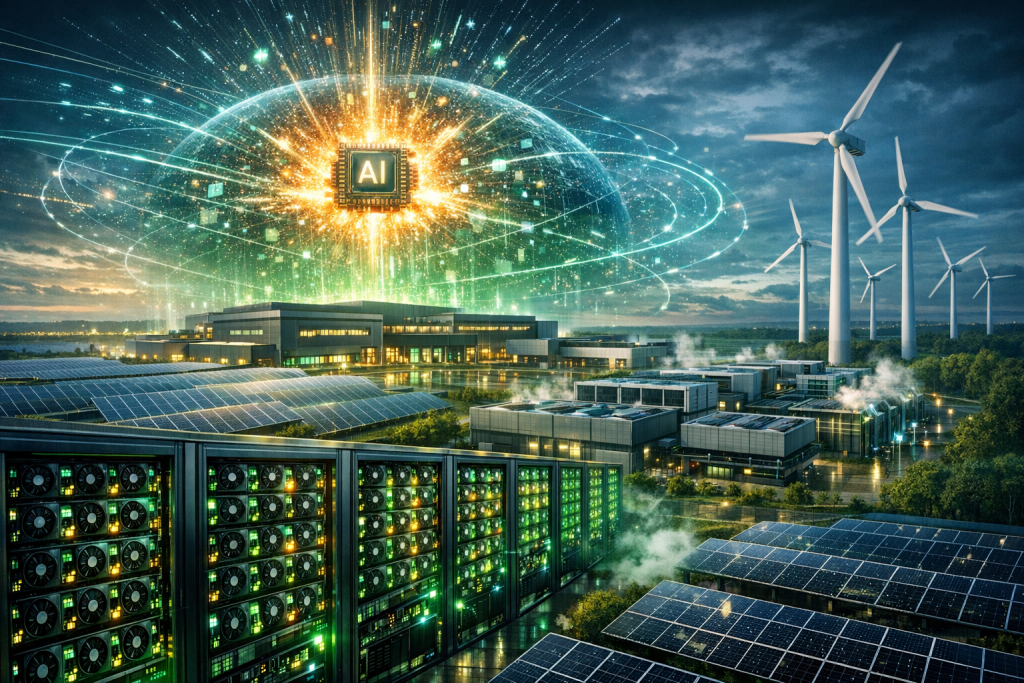
At the core of AI is computing power. Unlike traditional software, modern AI models require the processing of massive datasets and the execution of billions of calculations in extremely short periods of time. Training a large-scale AI model often requires tens of thousands of chips running simultaneously for weeks or even months. These chips—especially GPUs and AI accelerators—form the foundation that allows AI systems to learn, analyze, and make accurate predictions.
In this race, chipmakers such as NVIDIA, Intel, and AMD play a pivotal role. Their AI-focused processors have become not only essential computing tools but also strategic resources in the age of artificial intelligence. Demand for these chips has surged dramatically, at times leading to global shortages—highlighting the intensity of AI-driven growth.
As demand for computing power skyrockets, pressure shifts directly to data center infrastructure. Data centers are the “factories” of AI, housing thousands—or even tens of thousands—of servers, each equipped with high-performance chips. This is where AI models are trained, deployed, and delivered to users worldwide. Without data centers, AI simply cannot operate at scale.
As a result, leading technology companies such as Microsoft, Google, and Amazon are engaged in an unprecedented infrastructure investment race. Tens of billions of dollars are being poured annually into building and expanding data center networks across the globe. Next-generation data centers are not only larger, but also specifically designed for AI workloads, featuring higher server density, advanced cooling systems, and enormous power requirements.
Notably, each AI-focused data center may require tens of thousands of GPUs. This means the growth of data centers directly drives exponential demand for semiconductor chips. Conversely, advancements in chip technology enhance data center performance, enabling further AI development. This creates a powerful feedback loop in which AI, chips, and data centers continuously reinforce one another.
The impact of this trend extends far beyond the technology sector. Building large-scale data centers requires massive amounts of electricity and robust energy infrastructure. A single AI data center can consume as much power as a small city, forcing countries to upgrade their power grids and invest in sustainable energy sources. At the same time, the need for high-speed data transmission is accelerating investment in fiber optics, 5G networks, and cross-border connectivity.
In this context, ESG (Environmental, Social, and Governance) factors are becoming increasingly important in data center development. Technology companies are no longer competing solely on scale and performance—they must also ensure sustainability. Many modern data centers are designed with liquid cooling systems, powered by renewable energy such as solar and wind, and optimized for energy efficiency. These efforts are essential to balancing technological growth with environmental responsibility.
The explosion of AI is therefore not just a software revolution, but an infrastructure revolution. Semiconductor chips, data centers, and energy systems are emerging as the new pillars of the digital economy. Countries that can develop chip manufacturing capabilities, build large-scale data centers, and secure stable energy supplies will gain a significant competitive advantage in the global technology race.
For emerging economies such as Vietnam, this presents a strategic opportunity. By attracting investment in data centers, developing semiconductor talent, and building sustainable energy infrastructure, Vietnam can integrate more deeply into the global technology value chain. As AI continues to grow at an accelerating pace, demand for chips and data centers will not just increase—it will grow exponentially.
Ultimately, in the age of artificial intelligence, chips and data centers are no longer just technical components—they are the foundation of economic growth. The more AI advances, the greater the demand for chips, and the more data centers must expand. This self-reinforcing cycle is now reshaping the structure of the global digital economy in the 21st century.