


What is Synchronous Digital Hierarchy (SDH)?
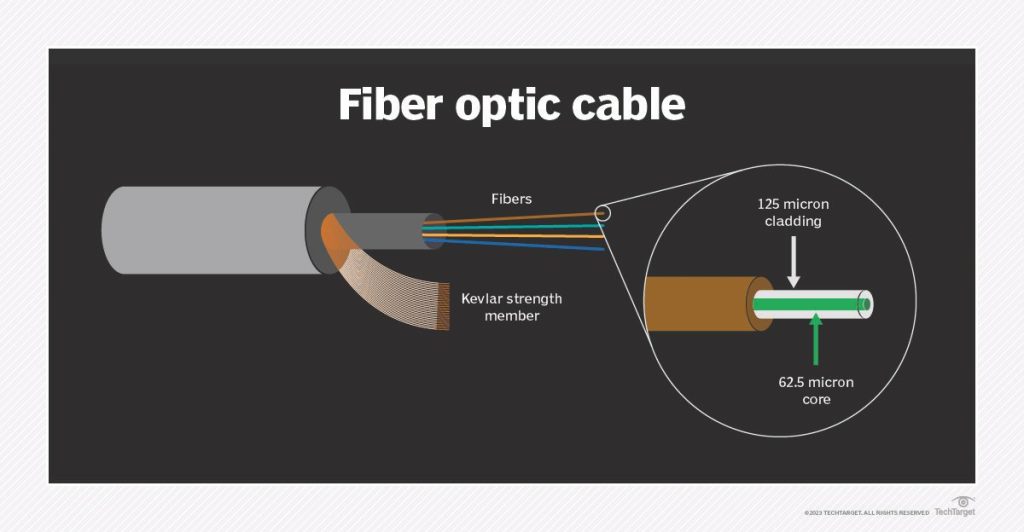
Synchronous Digital Hierarchy (SDH) is a family of transmission rates over optical fiber for transporting digital signals of varying capacity. SDH technology allows low-speed data streams to be combined with high-speed data streams. In addition, because the entire network operates synchronously, users can easily embed and extract individual bit streams from high-speed data streams.
SDH is the International Telecommunication Union (ITU-T)'s version of the SONET (Synchronous Optical Network) standard. Both technologies provide faster and more cost-effective networking than traditional Parasynchronous Digital Hierarchy (PDH) equipment.
SDH is used in transmission systems of the Broadband Integrated Services Digital Network (B-ISDN), transporting ATM (Asynchronous Transfer Mode) signals, Ethernet signals, PDH signals, storage area network (SAN) signals, and other communications signals.
SDH technology was developed in the late 1980s and early 1990s to replace PDH technology. The main goal was to eliminate potential synchronization problems in large data transmission and voice exchanges. In addition, data transmission speeds were also increased with a simpler and more flexible fiber optic network infrastructure.
In digital voice transmission:
Synchronous means that the bits from a call are transmitted in a single transmission frame.
Plesiochronous means nearly synchronous, that is, a call is extracted from many different transmission frames.
What is the difference between PDH technology and SDH transmission?
PDH technology has complex multiplexing techniques such as bit stuffing (inserting extra bits for synchronization) or interleaving (interleaving signals). Furthermore, the high cost of transmission bandwidth is a major limitation of PDH.
SDH technology does not use bit stuffing. Instead, the SDH system is based on byte interleaving, which ensures timing accuracy and provides greater flexibility.
SDH synchronous transport modules (STMs) and speeds include:
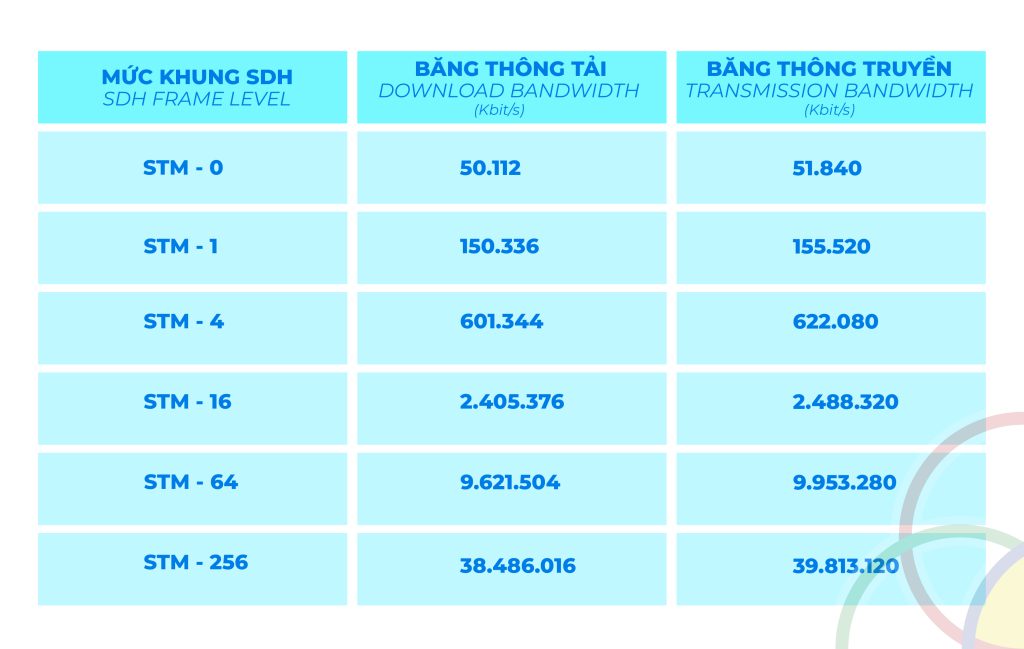
Data is transmitted over the SDH network in containers. Approximately 5% of the raw data rate is reserved for operation, management and maintenance purposes.
SDH operates primarily in software. It typically uses the Transaction Language 1/Q3 protocol to transport network management data between terminals and SDH equipment. In addition, SDH transmits network management data between SDH systems via dedicated embedded communication channels.
SDH uses connections based on: Fiber optic – Copper wire – Satellite and directional radio
Regenerators refresh a degraded or distorted signal, while Multiplexers combine signals into high-speed data streams. Users can also use virtual containers to transport individual data containers.
Main advantages of SDH technology
SDH technology has many advantages over traditional PDH, including:
- The technique of multiplexing and demultiplexing is simpler.
- Fiber optic bandwidth can be expanded without limit.
- Improved maintenance protocol, easily scalable to higher bit rates.
- Rings provide switching protection for data traffic.
- Connect quickly to a variety of networks.
- Comprehensive network management system.
- Flexible self-healing network.
- Supports transport of PDH, broadband and broadcast signals.
- Recover quickly from incidents.
- Provides transport services over a local area network (LAN) for interactive multimedia applications such as videoconferencing.
- Support multiple operators or providers.
- Supports multipoint networking.
Main disadvantages of SDH technology
Mặc dù có nhiều ưu điểm, SDH vẫn tồn tại một số nhược điểm như:
- Increases complexity when adding and detaching lower speed signals directly using pointers.
- Requires complex SDH equipment to manage different traffic types and options.
- Lower bandwidth usage compared to new technologies.
- E2 transport is not supported due to lack of suitable containers.
- Software dependent, vulnerable to cyber attacks.