


You may have heard data center administrators throw around some unfamiliar terms – what do they all mean? This roundup will help you understand.
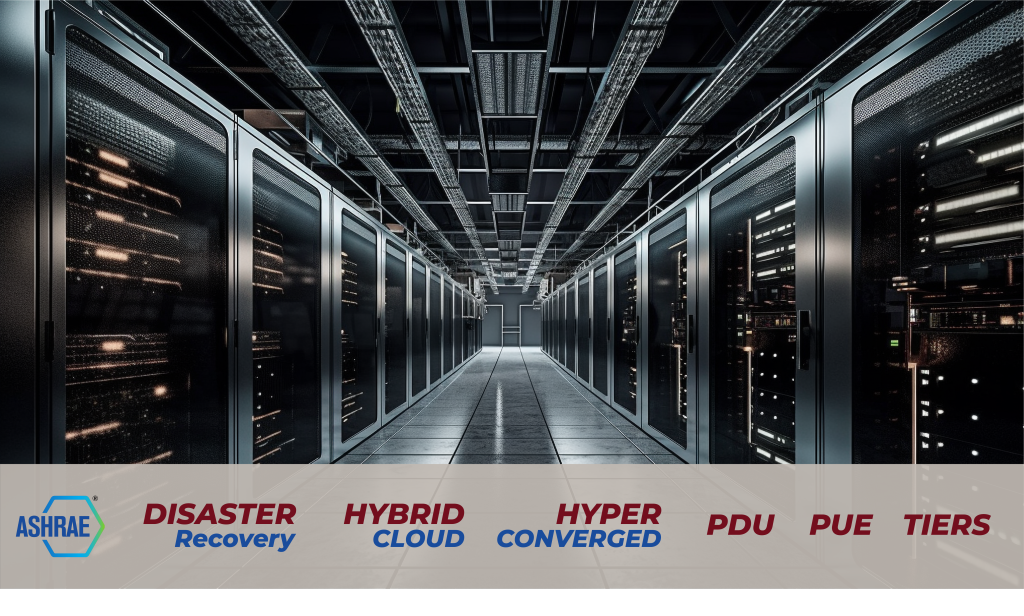
1. ASHRAE
ASHRAE stands for American Society of Heating, Refrigerating and Air-Conditioning Engineers.
In the data center field, the two most important technical committees are:
- Technical Committee 1.5: Computer Applications.
- Technical Committee 9.9: Critical Facilities, Data Centers, Technology Spaces and Electronics.
2. Blade Server
Blade servers are modular, space-saving, and easy-to-maintain servers. In a standard rack, hundreds of blade servers can occupy the same space as a few dozen traditional servers.
3. Close-Coupled Cooling
The interlock cooling mode is installed right next to the rack. This method is especially useful for racks containing high-temperature equipment that exceeds the cooling capacity of standard data center systems.
4. Clusters
Clusters are groups of servers that are networked together. Modern server clusters can be distributed remotely, virtualized, or software-defined. They are useful for applications that require multiple servers to operate in parallel.
5. Containers
Containers are compartmentalized areas within an operating system that allow applications to run independently. Docker, RKT, and Mesos are popular container technologies, while Kubernetes is an open source platform for managing and orchestrating containers.
6. Disaster Recovery (DR)
Disaster recovery systems ensure that data centers can resume operations quickly by backing up data at an off-site location. DR helps restore systems even in temporary configurations while waiting for troubleshooting.
7. Hybrid Cloud
Hybrid Cloud is a combination of public cloud and on-premise resources into one integrated environment. Managing a Hybrid Cloud system can be more complex than traditional models.
8. Hyper-Converged
Hyper-converged is a platform that integrates both hardware and software, acting as a miniature data center. This is a turnkey solution that simplifies infrastructure deployment and management.
9. PDU (Power Distribution Unit)
A PDU is a power distribution unit in a data center. It supplies power to the equipment in the rack and may include uninterruptible power supplies (UPS) to maintain operations in the event of a power outage.
10. PUE (Power Usage Effectiveness)
PUE measures the energy efficiency of a data center (according to ISO/IEC 30134-2:2016).
The formula for calculating PUE is:PUE = Total power consumption / Power consumption for IT equipment
- The ideal PUE is 1.
- Modern data centers typically have a PUE of 1.2 to 1.4.
- PUE above 1.5 means that energy efficiency needs to be improved.
11. Software-Defined
This concept refers to the separation of software and hardware in the data center. Software-defined allows network resources to be created, changed, expanded, or deleted using software, providing flexibility in management and deployment.
12. Các Tiers Của Data Center
According to the definition of Uptime Institute, data centers are divided into 4 levels (Tier) depending on the level of redundancy and fault tolerance:
- Tier 1: Most basic, uptime ≥ 99.671% (~28.8 hours downtime/year).
- Tier 2: Has a redundant system (N+1), uptime ≥ 99.741% (~22 hours downtime/year).
- Tier 3: Non-interruptible maintenance, uptime ≥ 99.982% (~1.6 hours downtime/year).
- Tier 4: Fully fault tolerant, uptime ≥ 99.995% (~26.3 minutes downtime/year).
In 2017, the Switch vendor defined itself as Tier 5 with more stringent standards, but it has not been officially recognized by the Uptime Institute.