


Artificial Intelligence (AI) is reshaping the way businesses manage their technology infrastructure – especially in the Data Center. As the world becomes increasingly digital, businesses are forced to optimize operations, improve efficiency, and reduce costs. In this process, AI has emerged as a key tool, promising automation, intelligent decision-making, and even self-healing systems. However, there is still a significant gap between promise and reality.
Smart Data Center – An Irreversible Trend
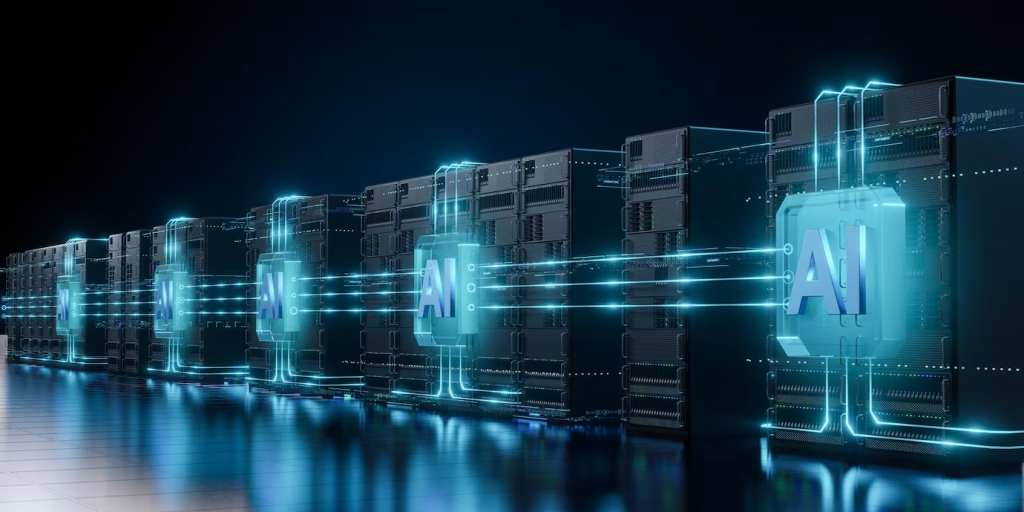
AI in the Data Center is no longer a science fiction story. As early as 2018, Google pioneered the transfer of cooling control in several hyperscale data centers to an AI system, thereby reducing cooling energy consumption by up to 40%. This is proof that AI can bring clear and measurable benefits.
The COVID-19 pandemic has accelerated this trend, said Mr. Tabet, an expert from Dell Technologies. Businesses today are not only looking for stability but also for resilience and continuous operation, leading to the need for a “Digital Data Center” powered by AI.
Practical Application: Great Opportunity – But Many Barriers
However, not every company has the scale and resources of Google. According to Daniel Bizo, senior analyst at 451 Research, most AI applications today are just support: analyzing equipment health, processing events, or optimizing cooling. Building a fully automated data center is still a long-term goal that requires years of development.
One of the biggest barriers is the human factor. According to Gartner, the lack of IT and data science skills is a serious problem in Data Center Operations teams. Michael Bushong of Juniper Networks says that “the biggest barrier is always people,” not just due to a lack of skills but also due to a fear of change. Many IT engineers still believe that “AI will take my job,” leading to resistance or slow adoption of new technology.
AI and the Performance Problem – From Energy to Workload
Optimize Energy Consumption
Data Centers consume about 3% of the world’s total electricity, contributing about 2% of greenhouse gas emissions. With such a significant number, AI is expected to help businesses not only save costs but also improve environmental responsibility.
AI systems can monitor, analyze, and predict cooling system anomalies – from uneven cold air distribution to inefficient HVAC operation. By automatically adjusting parameters, AI can improve performance without manual intervention.
Optimize Workload and Productivity
AI also helps solve the problem of “doing more with less.” Instead of just monitoring temperature or power consumption, modern systems can proactively move workloads away from overloaded or at-risk servers—avoiding service disruptions.
“The focus is no longer on pure power management, but on optimizing performance per watt – which means working smarter,” says StorageIO’s Greg Schulz.
Proactive Equipment Monitoring – Smart Maintenance
Modern Data Centers contain thousands of physical devices – from servers, storage devices to network switches. Manual monitoring and maintenance is nearly impossible. AI can help change this approach completely.
Machine learning algorithms can continuously collect telemetry data, detecting anomalies or trends that signal impending failure. Instead of scheduled maintenance, businesses can switch to condition-based maintenance, saving time and money.
In addition, AI also helps monitor “configuration drift” – a common phenomenon when device configurations are changed without strict control, which is a potential cause of security or performance errors.
Enhanced Security – Rapid Detection and Response
Data security is always a top priority for any Data Center. AI simplifies the security incident handling process by analyzing millions of events and alerts to filter out real threats.
AI can even detect unusual behavior in real time, isolate threats, and suggest immediate responses – something humans cannot do with huge amounts of data and requiring instantaneous responses.
The Future: Dynamic Workload Optimization

AI can not only help manage physical infrastructure, but can also automatically make decisions about distributing workloads across multiple platforms – from physical servers to different cloud environments. The algorithm will consider many factors: performance, cost, security, regulations, and even environmental sustainability.
However, as Bushong points out, currently only hyperscale providers like Google, Amazon, or Microsoft have the resources to implement comprehensive workload optimization models. For conventional enterprise data centers, this path is still challenging.
AI is clearly the future of the Data Center, but to get there, businesses need to start with small changes – optimizing cooling systems, monitoring smart devices, or simply early warning of system failures.
Instead of chasing hype, experts recommend focusing on “boring innovations”—but ones that deliver real value. Ultimately, success comes not from leaps and bounds, but from persistent incremental improvements.