


Saudi Arabia has officially launched an ambitious digital infrastructure initiative worth USD 2.7 billion (AED 9.9 billion) with the announcement of the Hexagon Data Center project, positioned as the world’s largest government data center and a flagship pillar of the country’s Vision 2030 strategy.
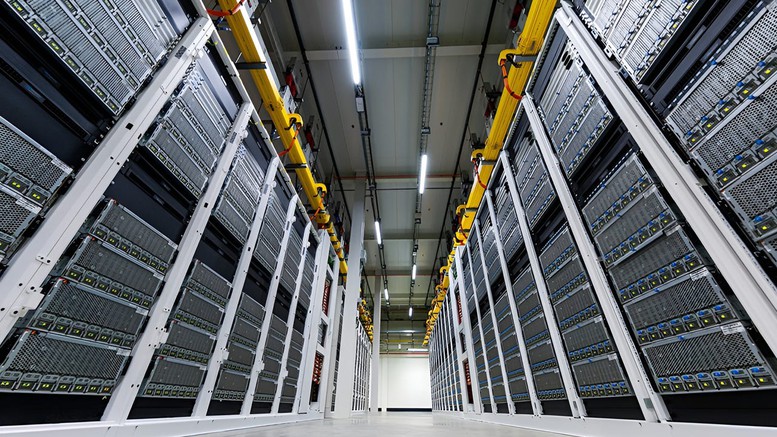
Rated Tier IV—the highest international standard for reliability—the Hexagon facility is designed to support the rapid expansion of public-sector digital services and accelerate Saudi Arabia’s transition toward a data-driven economy.
The project forms part of Riyadh’s broader commitment to ensuring technological sovereignty over national data, while simultaneously advancing economic diversification beyond oil dependence.
Hexagon will deploy advanced technologies to support key development sectors, at a time when data has become the primary driver of global socio-economic transformation.
Located in Riyadh, with a total area exceeding 30 million square feet and a capacity of 480 megawatts, Hexagon is expected to position Saudi Arabia as one of the world’s leading digital infrastructure hubs.
Designed to world-class standards, the Hexagon Data Center incorporates energy-efficient and intelligent cooling technologies, including direct liquid cooling and hybrid cooling systems, to reduce power usage effectiveness (PUE). Renewable energy sources are also integrated, placing the facility among the world’s largest “green” data centers and earning it LEED Gold certification from the U.S. Green Building Council.

According to the Saudi Data and Artificial Intelligence Authority (SDAIA), since 2018 the agency has integrated data from nearly 200 government entities into the Deem Cloud platform, where data from more than 250 data centers is centrally stored and accessed.
Projects such as Deem Cloud—consolidating the majority of government data into a single platform—highlight Saudi Arabia’s growing need for massive storage capacity and computing power, explaining the unprecedented scale of the Hexagon project.
Expert Carrington Malin noted that the rapid deployment of the Internet of Things (IoT)—from sensors and devices to traffic monitoring systems such as Saher, which operates across eight major cities using cameras to track traffic, detect violations, and monitor vehicles—has led to enormous data generation. In particular, real-time video processing can reach petabytes per month. Riyadh’s public transportation system alone operates approximately 14,000 cameras, placing significant pressure on data processing infrastructure.
Mohammed Soliman, Senior Research Fellow at the Middle East Institute in Saudi Arabia, observed that the 480-megawatt scale indicates this is not merely a project to modernize legacy government IT systems, but a strategic preparation for a surge in public-sector cloud computing demand.
According to Soliman, the Saudi government is planning for agent-based systems, integrated national databases, and workloads that cannot be hosted on foreign cloud platforms.
Once a sovereign data foundation is firmly established, part of Hexagon’s capacity may be selectively opened to the private sector, leading enterprises, and strategic national programs.
A National Data Center Network and the Ambition to Become a Global Digital Hub
The project was announced as Saudi Arabia ranks among global leaders in several indicators, including government strategy in the Global AI Index.
Data centers have evolved significantly since the 1950s, when they consisted of air-conditioned rooms housing early mainframe computers. Their role expanded with the internet boom of the late 1990s and further accelerated following the emergence of cloud computing in the mid-2000s. By 2020, governments worldwide had recognized data infrastructure as a strategic priority—a trend that has intensified with the rise of generative AI, which has dramatically increased demand for computing capacity.
Since its establishment in 2019, SDAIA has played a central role in Saudi Arabia’s national data and AI strategy, overseeing data governance, big data development, and AI regulation. This has positioned the Kingdom as a significant player in the global digital economy and a key destination for international technology investment in the region.
With SDAIA’s support, Saudi Arabia has built the region’s most advanced integrated data ecosystem, delivering innovative digital products with substantial socio-economic impact. The authority has also developed a comprehensive regulatory framework, including the Personal Data Protection Law, standards for generative AI, AI implementation frameworks, and international best practices to safeguard privacy and data integrity.
The Hexagon Data Center will serve as the foundation for a nationwide network of interconnected facilities, forming part of SDAIA’s expansion strategy to meet rising digital infrastructure demand while ensuring the highest levels of system availability.
Saudi Arabia’s efforts extend beyond technical infrastructure to initiatives such as Humain, a newly established company backed by the Public Investment Fund (PIF) and energy giant Aramco.
Created to support the Kingdom’s AI ambitions, Humain aims to position Saudi Arabia among the top three countries globally in AI infrastructure, alongside the United States and China.
(Source: cafef.vn)